
Introduction
Choosing the right cable tray is an important part of electrical and infrastructure planning. Cable trays provide a structured pathway for electrical, power, control, and communication cables while keeping installations organized, accessible, and easier to maintain.
Among the most commonly used options are perforated cable trays, ladder cable trays, and wire mesh cable trays. While all three are designed to support and route cables, their construction, ventilation, load capacity, installation requirements, and ideal applications can differ significantly.
So, which cable tray should you choose?
The answer depends on factors such as cable type, cable weight, ventilation requirements, installation environment, available space, maintenance needs, and project budget.
This guide compares perforated, ladder, and wire mesh cable trays to help you select the right solution for your project.
What Is a Cable Tray?
A cable tray is a support system used to route and organize electrical and communication cables within buildings, industrial facilities, commercial spaces, data centers, and infrastructure projects.
Instead of allowing cables to run loosely across ceilings, walls, floors, or service areas, cable trays provide a defined pathway. This improves cable organization and can make inspection, expansion, and maintenance easier.
Cable trays are available in different designs and materials. The three common designs discussed here are:
- Perforated cable trays
- Ladder cable trays
- Wire mesh cable trays
Each design has specific advantages and is suited to different installation conditions.
1. Perforated Cable Tray
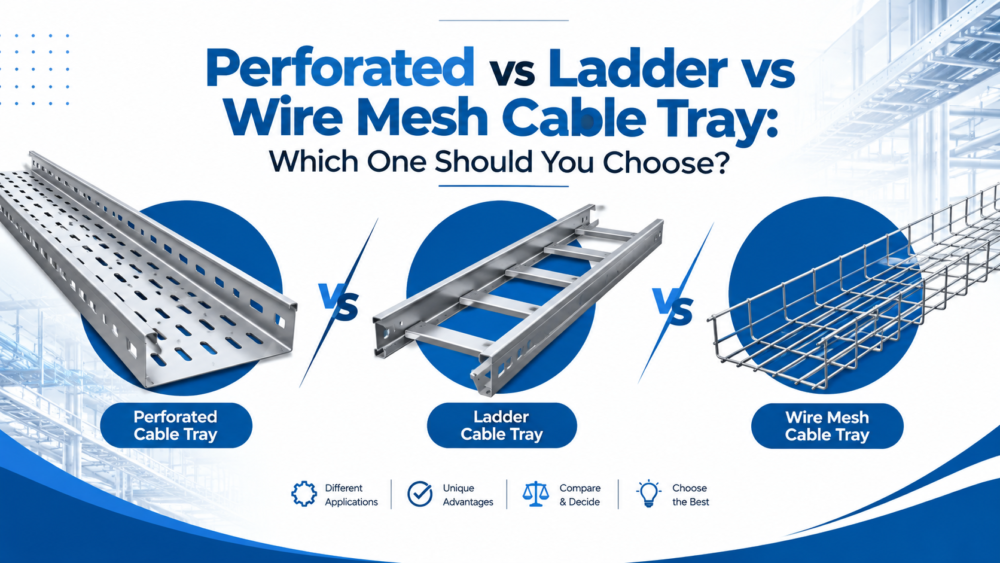
A perforated cable tray is manufactured from a metal sheet with regularly spaced holes or slots along its base and sides. These perforations help provide ventilation and can also be used for cable fastening and installation accessories.
Perforated trays are widely used for electrical power, control, instrumentation, and communication cable installations.
Key Features of Perforated Cable Trays
- Continuous base with ventilation openings
- Good cable support
- Suitable for small and medium-sized cables
- Easy cable fastening
- Provides protection from accidental impact compared with more open designs
- Available in different widths, heights, and thicknesses
- Can be manufactured with different surface finishes
Common finishes include galvanized, electroplated, painted, red oxide, and powder-coated finishes, depending on the required application and environment.
Where Are Perforated Cable Trays Used?
Perforated trays are suitable for:
- Commercial buildings
- Offices
- Hospitals
- Industrial facilities
- Manufacturing plants
- Electrical rooms
- Control rooms
- Warehouses
- Commercial complexes
- HVAC and building-services installations
They are particularly useful when cables need continuous support along the tray route.
Advantages of Perforated Cable Trays
The continuous base provides better support for cables than highly open tray designs. The perforations also allow some air circulation and provide convenient points for securing cables.
For projects requiring a balance between cable support, ventilation, accessibility, and protection, perforated cable trays are often a practical choice.
2. Ladder Cable Tray
A ladder cable tray consists primarily of two longitudinal side rails connected by horizontal rungs. The design resembles a ladder, which gives the tray its name.
The open structure provides excellent ventilation around the cables and allows cables to be easily installed, inspected, and accessed.
Ladder trays are commonly selected for installations where cable quantities and cable weights are relatively high.
Key Features of Ladder Cable Trays
- Two side rails connected by rungs
- Highly open construction
- Excellent airflow around cables
- Good accessibility
- Suitable for heavy cable loads
- Easy cable routing and maintenance
- Suitable for long cable runs
- Allows cables to be secured to rungs
Where Are Ladder Cable Trays Used?
Ladder cable trays are commonly used in:
- Power plants
- Manufacturing facilities
- Heavy industrial plants
- Infrastructure projects
- Large commercial facilities
- Utility installations
- Electrical substations
- Industrial cable corridors
- Large-scale power distribution systems
They are particularly useful where a project has large quantities of power cables or heavy cables.
Advantages of Ladder Cable Trays
The open design provides excellent ventilation, which can be beneficial when multiple cables generate heat during operation.
It also provides easy access. Installers and maintenance teams can reach cables from the top and secure them directly to the rungs where appropriate.
Another advantage is flexibility. Additional cables can generally be installed or removed without having to work inside a deep enclosed pathway.
For heavy-duty installations, ladder cable trays are often preferred because of their structural design and ventilation characteristics.
3. Wire Mesh Cable Tray
A wire mesh cable tray, also called a wire basket cable tray, is made from welded metal wires that form a basket-like structure.
Its open design provides high visibility and airflow while offering a lightweight solution for cable management.
Wire mesh trays are especially common in data centers, server rooms, telecom installations, and commercial IT environments.
Key Features of Wire Mesh Cable Trays
- Welded wire construction
- Lightweight compared with many heavy-duty tray systems
- Excellent ventilation
- Easy visual inspection of cables
- Flexible installation
- Simple cable access
- Suitable for data and communication cables
- Can be cut and adapted to suit certain installation routes
Where Are Wire Mesh Cable Trays Used?
Typical applications include:
- Data centers
- Server rooms
- Telecommunication facilities
- Network infrastructure
- Office buildings
- Commercial buildings
- IT infrastructure
- Low-voltage cable installations
- Communication systems
The open structure makes it particularly convenient for installations containing numerous network and communication cables.
Advantages of Wire Mesh Cable Trays
One of the biggest advantages is accessibility. Because the tray has an open wire structure, cables can be easily placed, identified, and maintained.
The design also promotes airflow, which can be valuable in environments where cable temperature management is important.
Wire mesh trays can also be easier to adapt around certain obstacles and installation routes, although the exact installation method depends on the tray system and manufacturer.
Perforated vs Ladder vs Wire Mesh Cable Tray
Although all three cable tray types perform the same fundamental function, their designs make them suitable for different applications.
| Feature | Perforated Cable Tray | Ladder Cable Tray | Wire Mesh Cable Tray |
|---|---|---|---|
| Construction | Perforated metal sheet | Side rails with rungs | Welded wire mesh |
| Cable Support | Very good | Excellent | Good |
| Ventilation | Good | Excellent | Excellent |
| Heavy Cable Loads | Good to very good, depending on design | Excellent | Generally better suited to lighter cable installations |
| Cable Access | Good | Excellent | Excellent |
| Common Application | Power, control and general electrical | Heavy power and industrial cables | Data, telecom and low-voltage cables |
| Maintenance Access | Good | Excellent | Excellent |
| Typical Environment | Commercial and industrial | Industrial and infrastructure | IT and commercial |
| Flexibility | Good | Good | Very good for adaptable routing |
The actual load capacity and suitability of any tray should always be confirmed using the manufacturer’s technical specifications and the project’s installation requirements.
Which Cable Tray Should You Choose?
There is no single cable tray that is ideal for every project. The right choice depends on the type and quantity of cables and the environment in which the tray will be installed.
Choose Perforated Cable Tray When:
A perforated cable tray is a strong option when you need continuous cable support combined with ventilation and organized routing.
Consider it for:
- General electrical installations
- Control cables
- Power cables
- Commercial buildings
- Industrial buildings
- Electrical rooms
- Building-services installations
It is particularly suitable when cables need to rest on a continuous tray surface.
Choose Ladder Cable Tray When:
A ladder cable tray is generally suitable for heavy-duty cable installations and large power cable runs.
Consider it when you have:
- Heavy power cables
- Large cable quantities
- Long cable routes
- Industrial installations
- Power distribution systems
- High ventilation requirements
Its open construction makes cable inspection and maintenance relatively straightforward.
Choose Wire Mesh Cable Tray When:
Wire mesh cable tray is often a practical choice for data, networking, telecommunications, and other lightweight cable systems.
Consider it for:
- Data centers
- Server rooms
- Network cabling
- Communication cables
- Low-voltage systems
- Office infrastructure
- IT installations
Its lightweight and highly accessible design can make it convenient for installations that require frequent cable additions or changes.
5 Factors to Consider Before Choosing a Cable Tray
Selecting a cable tray should not be based only on price or appearance. Consider the following factors before finalizing your cable management system.
1. Cable Weight
Determine the total weight of the cables that the tray will carry.
Heavy power cables may require a stronger tray system, while communication and network cables generally have lower loading requirements.
Always check the manufacturer’s specified load capacity and support-span recommendations.
2. Cable Type
Identify whether the installation contains:
- Power cables
- Control cables
- Instrumentation cables
- Data cables
- Communication cables
- Mixed cable types
Different cables may have different support, separation, and installation requirements.
3. Ventilation Requirements
Cable temperature can be affected by cable grouping, ambient conditions, and installation configuration.
Ladder and wire mesh trays provide highly open structures with strong airflow around cables, while perforated trays provide ventilation through their openings while retaining a more continuous support surface.
4. Installation Environment
Consider where the cable tray will be installed.
For example, an industrial facility may require a robust tray with an appropriate corrosion-resistant finish, while a data center may prioritize accessibility and cable management flexibility.
Environmental factors can include:
- Moisture
- Dust
- Chemicals
- Outdoor exposure
- Temperature
- Corrosive atmospheres
The tray material and surface finish should be selected accordingly.
5. Future Expansion
Cable installations often change over time. New equipment, additional power requirements, and network expansion can increase the number of cables.
If future expansion is expected, select a cable tray system with sufficient space and load capacity rather than designing only for the current installation.
Can You Use Different Cable Tray Types in the Same Project?
Yes. A project does not necessarily need to use only one type of cable tray.
Different tray designs can be selected for different sections of an installation.
For example, a large industrial facility could use ladder cable trays for heavy power cables, perforated cable trays for control and electrical cables, and wire mesh trays for communication or networking cables.
Using the appropriate tray for each application can provide better cable organization and make maintenance easier.
However, the complete installation should be designed as one coordinated cable management system. Tray dimensions, support structures, bends, junctions, covers, fittings, cable separation, and load requirements should all be considered together.
Perforated vs Ladder vs Wire Mesh: Quick Decision Guide
If you are still unsure which tray to select, use this simple approach:
For general electrical and control cable installations:
Choose a perforated cable tray when continuous cable support is important.
For heavy power cables and industrial installations:
Choose a ladder cable tray when high load capacity, ventilation, and accessibility are key priorities.
For data, networking, and communication cables:
Choose a wire mesh cable tray when lightweight construction, airflow, and easy cable access are important.
Final Thoughts
Perforated, ladder, and wire mesh cable trays each have a place in modern electrical and cable management systems.
Perforated cable trays provide a useful balance of continuous support, ventilation, and protection for many general electrical applications.
Ladder cable trays are well suited to heavy-duty installations where large or heavy cables require strong support and excellent ventilation.
Wire mesh cable trays offer an accessible and lightweight solution for data, telecommunications, networking, and other cable installations where flexibility and airflow are important.
The best choice ultimately depends on your cable type, load, installation environment, ventilation requirements, available space, maintenance needs, and future expansion plans.
Before installation, always verify tray dimensions, material, finish, load capacity, support spacing, and applicable electrical or project-specific requirements with the manufacturer or qualified electrical professional.
Frequently Asked Questions
Which is better, perforated or ladder cable tray?
Neither is universally better. Perforated trays provide continuous cable support and are suitable for many general electrical applications, while ladder trays are often preferred for heavy cable loads, large power cables, and installations requiring high ventilation.
Are wire mesh cable trays suitable for power cables?
They can be suitable for certain power-cable applications if the tray’s load capacity, dimensions, cable arrangement, and installation requirements are appropriate. For heavy-duty power installations, a suitably rated ladder or other robust tray system may be more appropriate.
Which cable tray is best for data centers?
Wire mesh cable trays are commonly suitable for data center and networking environments because they provide excellent accessibility, airflow, and flexibility for cable management.
Do perforated cable trays provide ventilation?
Yes. The openings in a perforated cable tray allow air to circulate around the cables while maintaining a relatively continuous support surface.
Which cable tray is best for heavy cables?
Ladder cable trays are commonly selected for heavy cable installations because their structural design provides strong support and excellent ventilation. The actual selection should be based on the required load capacity and manufacturer’s specifications.
Can cable trays be used outdoors?
Yes, cable trays can be used outdoors when the tray material, coating, finish, accessories, and installation method are suitable for the environmental conditions. Corrosion protection is particularly important in exposed or aggressive environments.
