
Introduction
Choosing the right cable management system is an important part of electrical installation design. Cables need proper support, protection, organization, and accessibility to ensure a reliable and maintainable electrical system.
Three commonly used solutions are cable trays, cable trunking, and electrical conduits. Although all three are used to route electrical cables, they differ significantly in their construction, level of protection, installation method, ventilation, accessibility, and typical applications.
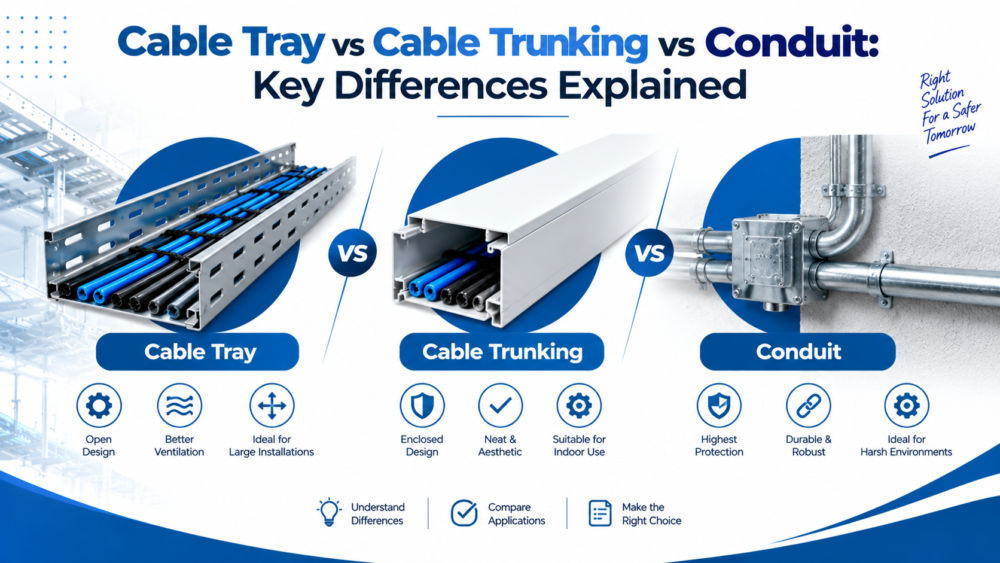
A cable tray is generally an open support system designed to carry multiple cables. Cable trunking provides a more enclosed pathway, while conduit provides a protective tube around individual or grouped cables.
Understanding these differences can help electrical contractors, engineers, facility managers, and project owners select the most suitable solution for a particular installation.
What Is a Cable Tray?
A cable tray is a support structure designed to carry and organize multiple electrical, power, control, instrumentation, or communication cables.
Cable trays are commonly manufactured from materials such as galvanized steel, stainless steel, aluminum, or other suitable materials. Depending on the application, they can have different surface finishes, including galvanized, electroplated, painted, or powder-coated finishes.
Common cable tray designs include:
- Perforated cable trays
- Ladder cable trays
- Wire mesh cable trays
- Solid-bottom cable trays
The open design of many cable trays allows cables to remain accessible for inspection, maintenance, and future expansion.
Where Are Cable Trays Used?
Cable trays are commonly found in:
- Industrial plants
- Manufacturing facilities
- Commercial buildings
- Power distribution systems
- Data centers
- Warehouses
- Hospitals
- Infrastructure projects
- Electrical rooms
- Utility installations
They are particularly useful when a project involves a large number of cables that need to follow a defined route.
Advantages of Cable Trays
Cable trays offer several practical benefits:
- Suitable for large cable quantities
- Easy cable installation and access
- Good ventilation
- Convenient maintenance
- Supports future cable expansion
- Available in different sizes and configurations
- Suitable for long cable runs
However, cable trays are generally more exposed than enclosed systems, so the appropriate tray design, material, finish, and accessories should be selected according to the installation environment.
What Is Cable Trunking?
Cable trunking is an enclosed or partially enclosed cable management system that provides a defined pathway for electrical wires and cables.
Unlike a typical open cable tray, trunking generally consists of a channel or enclosure with a removable or fixed cover. The cover helps protect cables from accidental contact, dust, impact, and other environmental factors, depending on the specific trunking design.
Cable trunking can be manufactured from materials such as metal or PVC, depending on the application.
Where Is Cable Trunking Used?
Cable trunking is commonly used in:
- Commercial buildings
- Offices
- Industrial facilities
- Electrical installations
- Control panels
- Workshops
- Building services
- Residential and commercial interiors
It is especially useful where cables need to be routed neatly along walls, ceilings, floors, or other building surfaces.
Advantages of Cable Trunking
Cable trunking provides:
- A neat cable-routing solution
- Additional physical protection
- Easy access when a removable cover is used
- Organized cable management
- A cleaner appearance in visible installations
- Separation options for different cable groups in some systems
Trunking can be particularly useful where the visual appearance of an installation matters or where cables need additional protection compared with an open tray.
What Is Electrical Conduit?
An electrical conduit is a tube used to protect and route electrical wires and cables.
Conduits are available in different materials and designs, including metal and non-metallic options. The appropriate type depends on factors such as the electrical installation, environmental conditions, mechanical protection requirements, and applicable standards.
Common conduit types include:
- Rigid metal conduit
- Flexible metal conduit
- PVC conduit
- Other approved non-metallic conduit systems
Unlike a cable tray, where multiple cables are supported openly, conduit surrounds the cables within a tubular pathway.
Where Is Conduit Used?
Conduit is widely used in:
- Residential buildings
- Commercial buildings
- Industrial facilities
- Machinery installations
- Electrical panels
- Workshops
- Outdoor installations
- Areas requiring additional mechanical protection
Conduit can be useful where cables need to be protected from physical damage or where the installation requires an enclosed cable pathway.
Advantages of Conduit
Key benefits include:
- Strong physical protection when appropriately specified
- Enclosed cable pathway
- Suitable for exposed installations
- Can provide a neat finished appearance
- Available in rigid and flexible configurations
- Useful for routing cables through walls, ceilings, machinery, and equipment areas
However, installing or modifying cables inside conduit can be more time-consuming than working with an open cable tray, particularly when there are long routes, numerous bends, or many cables.
Cable Tray vs Cable Trunking vs Conduit
The primary difference between these systems is how they support and protect cables.
| Feature | Cable Tray | Cable Trunking | Conduit |
|---|---|---|---|
| Basic Design | Open support system | Enclosed channel | Tubular enclosure |
| Cable Access | Very easy | Easy with removable cover | More restricted |
| Ventilation | Generally very good in open designs | Limited compared with open tray | Limited |
| Cable Capacity | Suitable for large cable quantities | Suitable for organized cable groups | Usually suited to smaller cable groups per pathway |
| Physical Protection | Moderate, depending on design | Good | Good to high, depending on type |
| Maintenance | Easy | Relatively easy | Can be more difficult |
| Cable Expansion | Convenient | Relatively convenient | More restrictive |
| Typical Use | Industrial and large installations | Building and organized routing | Protective cable routing |
| Installation | Supports cables along a route | Channels cables within an enclosure | Cables pulled or installed through a tube |
The exact performance of each system depends on the product design, material, installation method, cable arrangement, and applicable standards.
1. Cable Protection
Protection is one of the most important differences.
Cable trays generally provide support rather than complete enclosure. Their open design makes cables easy to access but leaves them more exposed to the surrounding environment.
Cable trunking provides greater enclosure. Its cover can protect cables from accidental contact and certain environmental or mechanical influences.
Conduit provides an enclosed tubular pathway and can offer substantial mechanical protection when the correct conduit type and installation method are used.
Therefore:
For accessibility: cable tray generally has an advantage.
For enclosed routing: trunking or conduit may be more suitable.
For higher mechanical protection: appropriately selected conduit can be advantageous.
2. Cable Capacity
Cable trays are often preferred when a project involves a large number of cables.
A tray can carry multiple cable types across a relatively wide pathway. The width and load capacity can be selected according to the installation requirements.
Trunking can also carry multiple cables, but its internal dimensions and enclosure design need to be considered carefully.
Conduit generally works better for individual circuits or smaller groups of cables because the internal space is restricted by the conduit diameter and cable installation requirements.
Cable fill and grouping requirements should always be considered rather than simply filling the available physical space.
3. Ventilation and Heat Dissipation
Cable temperature management is another important consideration.
Open cable trays allow air to circulate around cables, which can help with heat dissipation. This can be particularly useful for installations carrying power cables.
Trunking provides less natural airflow because cables are enclosed within a channel.
Conduit provides an even more enclosed pathway. Heat dissipation depends on the conduit material, cable arrangement, installation conditions, and design calculations.
For installations involving significant power cable loading, the designer should consider cable ampacity, grouping, ambient temperature, installation method, and applicable electrical requirements.
4. Installation and Maintenance
Cable trays are generally easy to work with because cables can be placed directly onto the tray. Installers can visually inspect the cable route and access individual cables without opening an enclosure.
Trunking also provides relatively convenient maintenance when the cover can be removed.
Conduit can require more planning during installation. Cables may need to be pulled through the conduit, and bends must be considered carefully. Once installed, accessing or replacing cables can take more effort.
This makes accessibility an important consideration when selecting the cable management system.
5. Appearance and Organization
Cable trunking is often selected where a clean and organized appearance is important.
For example, trunking can be installed along walls or other visible building surfaces to conceal and organize cables.
Cable trays provide an industrial and functional appearance. They are often installed above suspended ceilings, inside service areas, electrical rooms, factories, and other locations where cable accessibility is more important than concealment.
Conduit provides a structured and neat installation, particularly where cables need to travel along walls, equipment, machinery, or exposed surfaces.
When Should You Choose a Cable Tray?
A cable tray is generally a good choice when you need to manage multiple cables over long routes while maintaining easy access.
Consider cable trays for:
- Industrial plants
- Power distribution
- Large commercial buildings
- Data centers
- Manufacturing facilities
- Electrical rooms
- Control systems
- Large cable networks
Cable trays are particularly useful when future expansion and maintenance accessibility are important project requirements.
When Should You Choose Cable Trunking?
Cable trunking can be a practical choice when cables need to be organized within an enclosed channel.
Consider trunking for:
- Offices
- Commercial buildings
- Control installations
- Building services
- Visible cable routes
- Electrical installations requiring a cleaner appearance
- Applications where additional enclosure is beneficial
It can provide a good balance between cable organization, accessibility, appearance, and protection.
When Should You Choose Conduit?
Conduit is often suitable when physical protection and enclosed cable routing are important.
Consider conduit for:
- Individual electrical circuits
- Machinery wiring
- Exposed cable routes
- Wall and ceiling installations
- Areas subject to mechanical damage
- Outdoor or industrial applications where an appropriately rated conduit is required
- Installations where cables need to be enclosed
The conduit material and type should be selected based on the environment and required level of protection.
Can Cable Tray, Trunking, and Conduit Be Used Together?
Yes. In many real-world projects, these systems can complement each other rather than compete with one another.
For example, an industrial facility may use ladder or perforated cable trays for major cable routes. Near individual machines, cables may transition into conduit for additional protection.
Similarly, a commercial building could use cable trays above a ceiling for major cable distribution and trunking near visible areas where a cleaner appearance is preferred.
The transition between systems should be properly designed using suitable fittings, supports, cable protection, and installation practices.
How to Choose the Right Cable Management System
Before selecting a cable tray, trunking, or conduit, evaluate the following:
Cable Type
Identify whether the installation contains power, control, instrumentation, data, communication, or mixed cables.
Cable Quantity
A large number of cables may favor a tray system, while smaller cable groups may be more suitable for trunking or conduit.
Environmental Conditions
Consider moisture, dust, chemicals, temperature, outdoor exposure, corrosion, and mechanical risks.
Required Protection
Determine whether cables need open support, partial enclosure, or stronger physical protection.
Maintenance Requirements
If frequent cable inspection or expansion is expected, accessibility should be a major consideration.
Installation Space
Available ceiling, wall, floor, and equipment space can influence which cable management method is practical.
Future Expansion
Allow sufficient capacity for future cables rather than designing only for today’s requirements.
Applicable Standards
The selected system should comply with the relevant electrical codes, standards, project specifications, and manufacturer’s installation requirements applicable to the project.
Final Verdict: Cable Tray vs Trunking vs Conduit
There is no universal winner between cable tray, cable trunking, and conduit. Each system solves a different cable-management requirement.
Choose cable tray when you need to support and organize a large number of cables with excellent accessibility and ventilation.
Choose cable trunking when you want an organized, enclosed cable pathway with a clean appearance and convenient access.
Choose conduit when cables require an enclosed route and additional physical protection is an important consideration.
In larger electrical installations, using a combination of these systems can often provide the most practical solution. Cable trays can handle primary cable routes, trunking can organize building-level or visible cable pathways, and conduit can protect cables near equipment or in areas where additional enclosure is required.
Ultimately, the correct selection should be based on cable type, cable quantity, load, environmental conditions, mechanical protection, ventilation, installation space, maintenance requirements, and future expansion.
A properly selected cable management system does more than organize cables. It contributes to a safer, more accessible, maintainable, and reliable electrical installation.
Frequently Asked Questions
Is cable tray better than conduit?
Not necessarily. Cable tray is generally better suited to large cable quantities and installations where accessibility and ventilation are important. Conduit is more suitable when cables require an enclosed pathway and physical protection.
Is cable trunking the same as cable tray?
No. Cable trunking is generally an enclosed channel with a cover, while a cable tray is primarily a support system and is commonly open. Their applications and installation characteristics are different.
Which is best for industrial cable installation?
Cable trays are commonly suitable for major industrial cable routes because they can accommodate large quantities of cables and provide easy access. Conduit can be used near machinery or wherever additional cable protection is required.
Which is easier to maintain: tray, trunking, or conduit?
Cable trays are generally the easiest to access because cables are exposed and can be inspected directly. Trunking can also be relatively accessible when fitted with removable covers. Conduit typically provides more restricted access.
Can conduit connect to a cable tray?
Yes. Conduit can be used to transition cables from a cable tray to equipment, machinery, panels, or other locations where enclosed protection is required. Suitable fittings and installation practices should be used.
Which system is best for large numbers of cables?
Cable tray is generally the most practical option for large cable quantities because trays can be manufactured in various widths and configurations and provide convenient cable access. The tray’s load capacity and cable arrangement should be properly evaluated during design.
