
Introduction
Choosing the right material and finish for a cable tray is just as important as selecting the right tray design. Cable trays are often installed in environments where they are exposed to moisture, humidity, chemicals, temperature changes, dust, and other conditions that can contribute to corrosion.
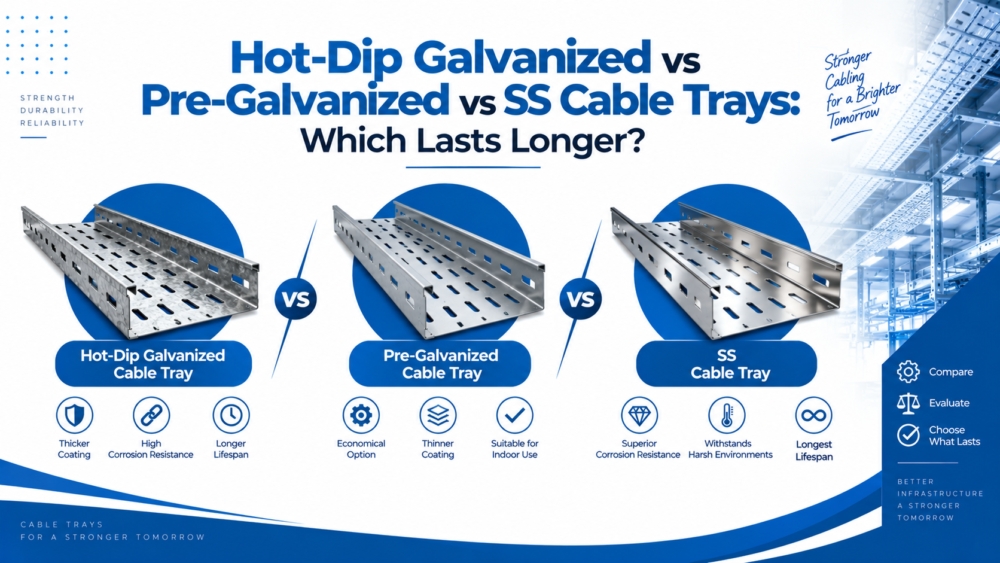
Three common options are Hot-Dip Galvanized (HDG) cable trays, Pre-Galvanized cable trays, and Stainless Steel (SS) cable trays.
All three offer corrosion resistance, but they do not perform identically in every environment. Their durability depends on the coating or material, installation conditions, exposure level, maintenance, and the quality of manufacturing.
So, which cable tray lasts longer?
In general, stainless steel can provide the longest service life in highly corrosive environments, while hot-dip galvanized cable trays can offer excellent long-term corrosion protection for many industrial and outdoor applications at a lower cost. Pre-galvanized trays can be an economical choice for relatively mild environments.
Let’s compare these three options in detail.
What Is a Galvanized Cable Tray?
Galvanization is a corrosion-protection process in which steel is protected using a zinc coating.
Zinc acts as a protective barrier between the steel and the surrounding environment. It can also provide sacrificial protection to exposed steel areas because zinc is more reactive than steel.
However, not all galvanized cable trays are manufactured using the same process.
The two important categories are:
- Pre-galvanized cable trays
- Hot-dip galvanized cable trays
Although both use zinc to protect steel, the coating is applied at different stages of manufacturing.
What Is a Pre-Galvanized Cable Tray?
A pre-galvanized cable tray is manufactured from steel that has already been coated with zinc before the tray components are formed or fabricated.
The galvanized steel sheet or strip is processed into the required tray components through cutting, bending, punching, forming, and other manufacturing operations.
Because the steel is galvanized before fabrication, the coating provides protection across most of the original sheet surface.
Advantages of Pre-Galvanized Cable Trays
Pre-galvanized trays offer several benefits:
- Cost-effective compared with stainless steel
- Good corrosion resistance for many indoor applications
- Clean and consistent appearance
- Suitable for commercial installations
- Relatively lightweight
- Efficient manufacturing process
- Suitable for controlled environments
They are commonly used in:
- Offices
- Commercial buildings
- Indoor electrical rooms
- Warehouses
- Data and communication installations
- Building services
- General industrial environments with limited corrosive exposure
Limitations of Pre-Galvanized Cable Trays
The main consideration is that cutting, drilling, punching, bending, or fabrication performed after galvanization can expose areas of the underlying steel.
The level of protection at these areas depends on the manufacturing process and whether appropriate corrosion-protection measures are applied.
For this reason, pre-galvanized cable trays may not always be the first choice for highly corrosive outdoor or industrial environments.
What Is a Hot-Dip Galvanized Cable Tray?
A Hot-Dip Galvanized (HDG) cable tray is generally fabricated from steel and then immersed in molten zinc.
During the hot-dip galvanizing process, the steel reacts with the molten zinc and forms a metallurgically bonded zinc coating over the steel surface.
This process can provide a robust coating that covers the fabricated tray, including areas that may have been cut, drilled, or formed during manufacturing, subject to proper galvanizing practice.
Advantages of Hot-Dip Galvanized Cable Trays
HDG cable trays are widely selected for demanding applications because they can provide strong corrosion protection and durability.
Key advantages include:
- Strong zinc coating
- Good resistance to atmospheric corrosion
- Suitable for outdoor installations
- Suitable for many industrial environments
- Good long-term durability
- Protection across the fabricated component
- Suitable for infrastructure and utility projects
Common applications include:
- Outdoor cable routes
- Manufacturing plants
- Power plants
- Industrial facilities
- Infrastructure projects
- Utility installations
- Rooftop installations
- Construction projects
- Areas exposed to moisture and weather
The actual service life depends heavily on the environment and coating thickness.
What Is an SS Cable Tray?
An SS cable tray, or stainless steel cable tray, is manufactured from stainless steel rather than relying on a zinc coating over carbon steel.
Stainless steel contains chromium, which helps form a passive oxide layer on the surface. This passive layer provides corrosion resistance and can reform when the surface is exposed to oxygen.
Different stainless steel grades have different corrosion-resistance characteristics.
For example, commonly used grades include 304 and 316 stainless steel, but the correct grade should be selected based on the installation environment.
Advantages of Stainless Steel Cable Trays
Stainless steel offers:
- Excellent corrosion resistance
- Long service life in suitable environments
- High resistance to many corrosive conditions
- Good appearance
- Low maintenance requirements
- Good performance in humid environments
- Suitability for demanding industrial applications
Stainless steel cable trays can be particularly useful in:
- Chemical facilities
- Food-processing environments
- Pharmaceutical facilities
- Coastal areas
- Marine environments
- High-humidity locations
- Clean and hygienic installations
- Aggressive industrial environments
However, stainless steel is generally more expensive than galvanized steel, so it should be selected when its corrosion-resistance benefits justify the additional investment.
Hot-Dip Galvanized vs Pre-Galvanized vs Stainless Steel
The most important differences are related to corrosion resistance, environment, cost, maintenance, and expected service life.
| Feature | Pre-Galvanized | Hot-Dip Galvanized | Stainless Steel |
|---|---|---|---|
| Base Material | Galvanized steel | Steel with zinc coating | Stainless steel |
| Corrosion Protection | Good in suitable environments | Very good in many outdoor/industrial environments | Excellent, depending on grade |
| Outdoor Use | Suitable for selected environments | Highly suitable when properly specified | Highly suitable |
| Humidity Resistance | Good | Very good | Excellent |
| Aggressive Environment | Limited to moderate | Good to very good depending on exposure | Excellent with suitable grade |
| Maintenance | Low to moderate | Low | Generally low |
| Initial Cost | Lower | Moderate | Higher |
| Typical Application | Indoor/commercial | Outdoor/industrial | Corrosive or demanding environments |
| Expected Service Life | Environment dependent | Often long | Often very long |
These comparisons are general. Actual performance should be determined using the selected material grade, coating thickness, environmental exposure, and applicable standards.
Which Cable Tray Lasts the Longest?
If the only question is which material can provide the longest service life in a highly corrosive environment, stainless steel is often the strongest option.
However, that does not mean stainless steel is always the best choice.
A properly specified hot-dip galvanized cable tray can provide a very long service life in many outdoor and industrial environments. In numerous projects, HDG provides an effective balance between durability, corrosion protection, availability, and cost.
Pre-galvanized cable trays can also provide reliable service when installed in environments where the corrosion exposure is relatively controlled.
Therefore, service life should not be judged by material name alone.
The environment is one of the biggest factors.
1. Indoor and Controlled Environments
For indoor commercial installations with limited moisture and corrosive exposure, pre-galvanized cable trays can often provide sufficient corrosion resistance.
Examples include:
- Offices
- Commercial buildings
- Indoor electrical rooms
- Warehouses
- Building service areas
In these environments, choosing stainless steel may provide more corrosion resistance than the application actually requires.
2. Outdoor Installations
Outdoor installations expose cable trays to rain, humidity, condensation, temperature changes, and atmospheric pollutants.
For these applications, hot-dip galvanized cable trays are commonly considered because the zinc coating provides substantial protection against atmospheric corrosion.
The required coating and design should be selected based on the expected environmental exposure.
Stainless steel can also be an excellent option, particularly where the environment is highly corrosive or where long service life and reduced maintenance justify the higher initial cost.
3. Coastal and Marine Environments
Coastal environments can be challenging because salt-laden air can accelerate corrosion.
In such locations, stainless steel, particularly an appropriately selected grade, can offer excellent corrosion resistance.
The suitability of a particular stainless steel grade depends on factors such as chloride exposure and the specific environment.
Hot-dip galvanized systems can also be used in certain coastal applications, but the expected corrosion exposure and required coating performance should be carefully evaluated.
4. Chemical and Industrial Environments
Industrial plants may expose cable trays to chemicals, fumes, moisture, and elevated temperatures.
In these environments, the correct material should be selected based on the specific chemical and environmental exposure.
Stainless steel can be advantageous in aggressive environments, but even stainless steel is not resistant to every chemical condition.
For demanding installations, material selection should be based on documented compatibility rather than assumptions.
5. Humid and High-Moisture Areas
Humidity and condensation can accelerate corrosion of carbon steel.
For moderately humid environments, a suitable galvanized tray can provide effective protection.
For continuously wet or highly corrosive environments, stainless steel may provide a longer service life depending on the stainless steel grade and installation conditions.
Cost Comparison
Initial cost is another major difference between these three options.
Pre-Galvanized
Pre-galvanized cable trays are generally the most economical option of the three.
They can be a practical choice where corrosion exposure is limited and the project prioritizes cost efficiency.
Hot-Dip Galvanized
HDG cable trays generally cost more than standard pre-galvanized trays because of the additional galvanizing process.
However, the improved corrosion protection can make HDG a cost-effective choice for outdoor and industrial installations.
Stainless Steel
Stainless steel generally has the highest initial material cost.
However, initial purchase price is not the only factor to consider.
If a stainless steel tray lasts substantially longer or requires less maintenance in a highly corrosive environment, its lifecycle cost can become competitive.
Initial Cost vs Lifecycle Cost
A common mistake when selecting cable trays is to compare only the purchase price.
A better approach is to consider total lifecycle cost.
Lifecycle cost can include:
- Initial material cost
- Installation
- Maintenance
- Inspection
- Repairs
- Replacement
- Downtime
- Expected service life
For a controlled indoor environment, pre-galvanized cable trays may offer excellent value.
For outdoor industrial installations, HDG can provide a good balance of cost and durability.
For highly corrosive environments, stainless steel may justify its higher initial cost through longer service life and reduced maintenance.
What About Scratches and Cut Edges?
Cable tray fabrication and installation can involve cutting, drilling, bending, and fastening.
With galvanized steel, exposed areas created during fabrication should be addressed according to the applicable galvanizing and corrosion-protection practice.
Hot-dip galvanizing performed after fabrication can provide coating coverage over the fabricated component, including many edges and surfaces.
With pre-galvanized material, fabrication after galvanization can leave areas where the original zinc coating has been removed or damaged.
Stainless steel does not rely on a zinc coating. Its corrosion resistance comes from the properties of the alloy and its passive surface layer.
Nevertheless, stainless steel surfaces should also be fabricated and handled correctly to avoid contamination and maintain corrosion performance.
How to Choose the Right Cable Tray Finish
Instead of simply asking, “Which cable tray lasts longest?”, ask:
Where will the cable tray be installed?
Then consider:
For indoor commercial applications:
Pre-galvanized cable tray can be a practical and economical choice.
For outdoor and industrial applications:
Hot-dip galvanized cable tray is often a strong option where good corrosion protection is required.
For highly corrosive environments:
Stainless steel cable tray may be the better long-term solution, with the appropriate grade selected for the environment.
For coastal or marine exposure:
Consider appropriately graded stainless steel or a suitably engineered galvanized system based on the specific exposure conditions.
7 Factors That Affect Cable Tray Service Life
Material selection is important, but several other factors influence how long a cable tray will remain functional.
1. Environmental Exposure
Moisture, salt, chemicals, pollution, and humidity can significantly influence corrosion rates.
2. Coating Thickness
For galvanized products, zinc coating thickness affects corrosion protection. The required coating should be selected according to the relevant specification and environmental conditions.
3. Installation Quality
Improper cutting, drilling, fastening, storage, or handling can compromise corrosion protection.
4. Drainage
Outdoor cable trays should be installed in a way that avoids unnecessary water accumulation.
5. Material Compatibility
Contact between dissimilar metals can create galvanic-corrosion concerns under certain conditions. Appropriate design and compatible accessories should be considered.
6. Maintenance
Periodic inspection can identify corrosion, coating damage, loose fittings, or other issues before they become significant.
7. Correct Material Selection
The most durable cable tray is not necessarily the one with the highest corrosion resistance. It is the one appropriately specified for the actual environment.
Final Verdict: HDG vs Pre-Galvanized vs SS Cable Tray
So, which lasts longer?
In highly corrosive environments, stainless steel cable trays can offer the longest service life when the correct stainless steel grade is selected.
Hot-dip galvanized cable trays can provide excellent durability and corrosion protection for many outdoor, industrial, and infrastructure applications, making them a strong balance between performance and cost.
Pre-galvanized cable trays are generally better suited to controlled indoor or relatively mild environments where extreme corrosion resistance is not required.
The best choice depends on more than expected lifespan. Consider the environment, moisture exposure, chemical exposure, temperature, installation conditions, maintenance requirements, coating specifications, project budget, and expected service life before selecting a cable tray.
A properly specified pre-galvanized tray can outperform an unnecessarily expensive material in the right environment, while stainless steel can be the more economical lifecycle choice when corrosion exposure is severe.
The goal should therefore be to select the right cable tray material for the environment, rather than simply choosing the most corrosion-resistant option available.
Frequently Asked Questions
Is hot-dip galvanized better than pre-galvanized cable tray?
For many outdoor and industrial applications, hot-dip galvanizing can provide stronger and more comprehensive corrosion protection because the fabricated component is galvanized after manufacturing. Pre-galvanized trays can be suitable for controlled environments and can offer a more economical solution.
Is stainless steel better than galvanized cable tray?
Stainless steel can provide superior corrosion resistance in many aggressive environments, but it costs more. Galvanized steel can provide excellent performance in many indoor, outdoor, and industrial applications at a lower initial cost.
Which cable tray is best for outdoor use?
Hot-dip galvanized cable trays are commonly suitable for outdoor installations because of their zinc coating and corrosion protection. Stainless steel may be preferable for highly corrosive environments.
Which cable tray is best for coastal areas?
The appropriate choice depends on the level of chloride and moisture exposure. Stainless steel of a suitable grade can be a strong option for highly corrosive coastal environments. A properly specified galvanized system may also be suitable for some applications.
Does stainless steel cable tray rust?
Stainless steel is highly corrosion resistant, but it is not completely immune to corrosion. Its performance depends on the stainless steel grade, environmental exposure, surface condition, contamination, and installation practices.
Are pre-galvanized cable trays suitable for indoor use?
Yes. Pre-galvanized cable trays are commonly suitable for indoor
